
What We Learned About Democracy: Five Reflections from the Nyansa Institute's Second Dialogue
By the Nyansa Institute for Strategic Dialogue
For more than three decades, Ghana has stood out as one of West Africa’s most stable democracies. It has witnessed peaceful transfers of power, competitive elections, an active media, and a constitutional order that has endured while several neighbouring countries have experienced political instability.
But can Ghana’s democratic success continue? And what responsibility does it carry in a region where democracy faces
growing pressures?
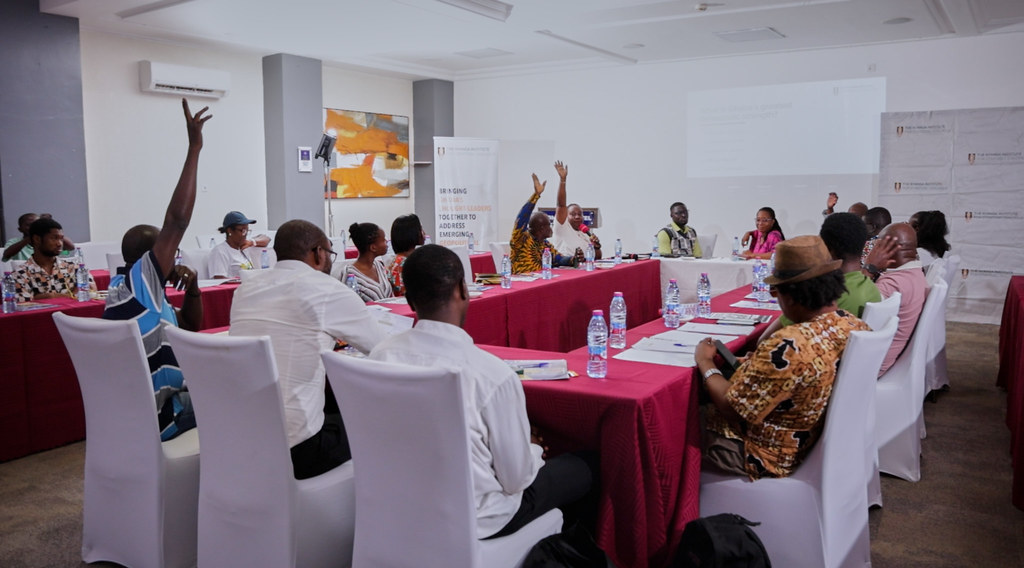
These questions formed the basis of the Nyansa Institute for Strategic Dialogue’s second Dialogue Series, held in Accra under the theme “How Can Ghana Be a Democratic Anchor for West Africa?”
Bringing together researchers, policy practitioners, civil society representatives, professionals, and citizens, the evening’s discussion moved beyond celebrating Ghana’s democratic record. Instead, it challenged participants to examine what makes democracy resilient and what it will take to strengthen democratic governance both at home and across the region.
Several important themes emerged.
- Democracy cannot be measured by elections alone.
One of the strongest messages from the discussion was that democracy extends far beyond the ballot box. Free and fair elections remain fundamental, but they represent only one part of a healthy democratic system. Citizens also judge democracy by whether public institutions are accountable, whether justice is applied fairly, whether governments deliver on their promises, and whether people have meaningful opportunities to participate in decision-making between elections.When democratic institutions fail to meet public expectations, confidence in the system can weaken, even where elections continue to take place regularly.
The discussion therefore challenged participants to think of democracy not simply as an event held every four years, but as a continuous relationship between citizens and the institutions that serve them.
- Ghana’s democratic stability is an opportunity—but not a guarantee.
Ghana’s democratic reputation has become one of its greatest national assets.
While several countries in West Africa have experienced unconstitutional changes of government in recent years, Ghana has maintained constitutional rule through successive peaceful elections.Yet panellists cautioned against viewing this record as permanent or inevitable. Democratic stability is sustained through deliberate investment in strong institutions, respect for the rule of law, credible elections, and public trust. These achievements cannot be taken for granted.Rather than asking why Ghana has remained stable, the discussion encouraged participants to ask a more important question:
How can Ghana use its experience to strengthen democratic governance across the wider region?
Whether through diplomacy, peer learning, institutional cooperation, or leadership within regional organisations, Ghana has an opportunity to contribute positively to democratic resilience in West Africa.
- Strong institutions—not strong personalities—protect democracy.
Throughout the evening, participants repeatedly returned to the importance of institutions. Independent courts, effective legislatures, professional public services, electoral management bodies, and accountable oversight institutions form the foundation upon which democratic governance rests.
When institutions function effectively, they provide continuity beyond individual political leaders. When institutions become weak, democracy itself becomes more vulnerable.
The discussion reinforced the idea that building resilient democratic institutions requires long-term commitment rather than short-term political advantage.
- Young people must become active participants—not observers.
Another recurring theme centred on the role of young people. Across Africa, young people represent the majority of the population, yet many continue to feel disconnected from formal political processes.
Participants argued that strengthening democracy requires moving beyond encouraging young people simply to vote. Instead, young citizens should be supported to engage in public debate, community leadership, policy development, civic organisations, entrepreneurship, and public service.
A democracy that fails to harness the energy, creativity, and ideas of its youth risks becoming less responsive to future generations.
- Dialogue remains one of democracy’s greatest strengths.
Perhaps the most important lesson from the evening was the value of dialogue itself. Participants represented diverse professional backgrounds, experiences, and perspectives. At times they disagreed. They challenged assumptions, questioned existing approaches, and offered different ideas for strengthening democratic governance.
Yet these differences did not divide the room. Instead, they demonstrated one of democracy’s defining characteristics: the ability to exchange ideas respectfully in pursuit of better outcomes. In an era increasingly characterised by political polarisation, misinformation, and fragmented public discourse, creating spaces for thoughtful, evidence-informed conversation is itself an important democratic practice.
Looking Ahead
Democracy is often described as a journey rather than a destination.
Its strength depends not only on constitutions or elections, but also on the willingness of citizens to remain engaged, institutions to remain accountable, and leaders to place national interests above political expediency.
Ghana’s democratic experience offers valuable lessons, both for itself and for the wider West African region. However, preserving that experience will require continual reflection, institutional renewal, and sustained civic participation.
The Nyansa Institute for Strategic Dialogue was established on the belief that better conversations can lead to better policy, stronger institutions, and more informed public decision-making.
Our Dialogue Series seeks to contribute to that mission by bringing together diverse voices to examine complex issues through respectful, evidence-based discussion.
As Ghana continues its democratic journey, one thing remains clear: safeguarding democracy is not the responsibility of governments alone. It is a shared responsibility that belongs to every citizen.
The conversation does not end here.
It is only just beginning.
Stay Updated
We aim to host a panel discussion every six weeks, bringing together experts, policymakers and thought leaders to explore the latest developments in geopolitics and international affairs.
If you’d like to be among the first to hear about upcoming events, complete the form below to register your interest. We’ll notify you as soon as new events are announced.